How to Hit a Vein Successfully: Practical Tips for Beginners and Healthcare Professionals
Practical Tips for Beginners and Healthcare Professionals
Successfully hitting a vein isn't about luck—it's about proper assessment, preparation, and technique. Whether you're a phlebotomy student, nurse, EMT, or experienced healthcare professional, consistent first-stick success comes from understanding selecting the right vein, and practicing under expert guidance. While no article can replace supervised clinical training, learning the principles behind successful venipuncture can help you build confidence and improve patient care.
At Vein Access Technologies (VAT) in East Alton, Illinois, we've spent decades teaching healthcare professionals throughout the Greater St. Louis area that the secret to successful venipuncture begins long before the needle is ever inserted.
What Is the Best Way to Hit a Vein?
The best way to hit a vein is to perform a thorough vein assessment, identify an appropriate vein through both visual inspection and palpation, properly prepare the patient, and use evidence-based venipuncture techniques learned through professional training. Successful clinicians rely on knowledge and experience—not guesswork—to achieve consistent first-stick success.
Why Vein Assessment Is More Important Than Needle Placement
One of the biggest misconceptions among new healthcare professionals is that successful venipuncture depends primarily on needle placement.
In reality, experienced clinicians know that vein assessment determines success long before the needle enters the skin.
Before selecting a vein, evaluate several important factors:
- Size and diameter
- Depth below the skin
- Direction of the vein
- Elasticity and resilience
- Stability during palpation
- Patient hydration
- Previous venipuncture history
- Medical conditions that may affect
The median cubital vein is commonly preferred because of its size and stability, but it isn't always the best choice for every patient. Depending on individual anatomy, the cephalic or basilic vein may provide a better option.
At Vein Access Technologies, one lesson consistently reinforced during training is that the best vein isn't necessarily the most visible—it's the vein that can be confidently assessed through both sight and touch.
Five Ways to Improve First-Stick Success
1. Never Rush Your Assessment
One of the most common reasons clinicians miss veins is simply moving too quickly.
Taking an extra moment to evaluate vein quality often results in a smoother procedure and a better patient experience.
2. Develop Strong Palpation Skills
Beginners often rely almost entirely on what they can see.
Experienced clinicians rely just as much on what they can feel.
Learning to recognize vein elasticity, direction, and resilience through palpation is one of the most valuable skills taught during professional phlebotomy education.
Instructors at VAT frequently observe that students improve dramatically once they learn to trust their fingertips rather than searching only for highly visible veins.
3. Position the Patient Correctly
Proper positioning helps veins fill naturally and allows patients to remain comfortable throughout the procedure.
Simple adjustments in arm position can significantly improve vein assessment without increasing patient discomfort.
4. Apply the Tourniquet Properly
A correctly applied tourniquet temporarily slows venous return while maintaining arterial circulation.
Improper placement can make veins more difficult to assess and may affect specimen quality.
Learning proper tourniquet technique is a fundamental component of quality phlebotomy education.
5. Practice Under Experienced Instructors
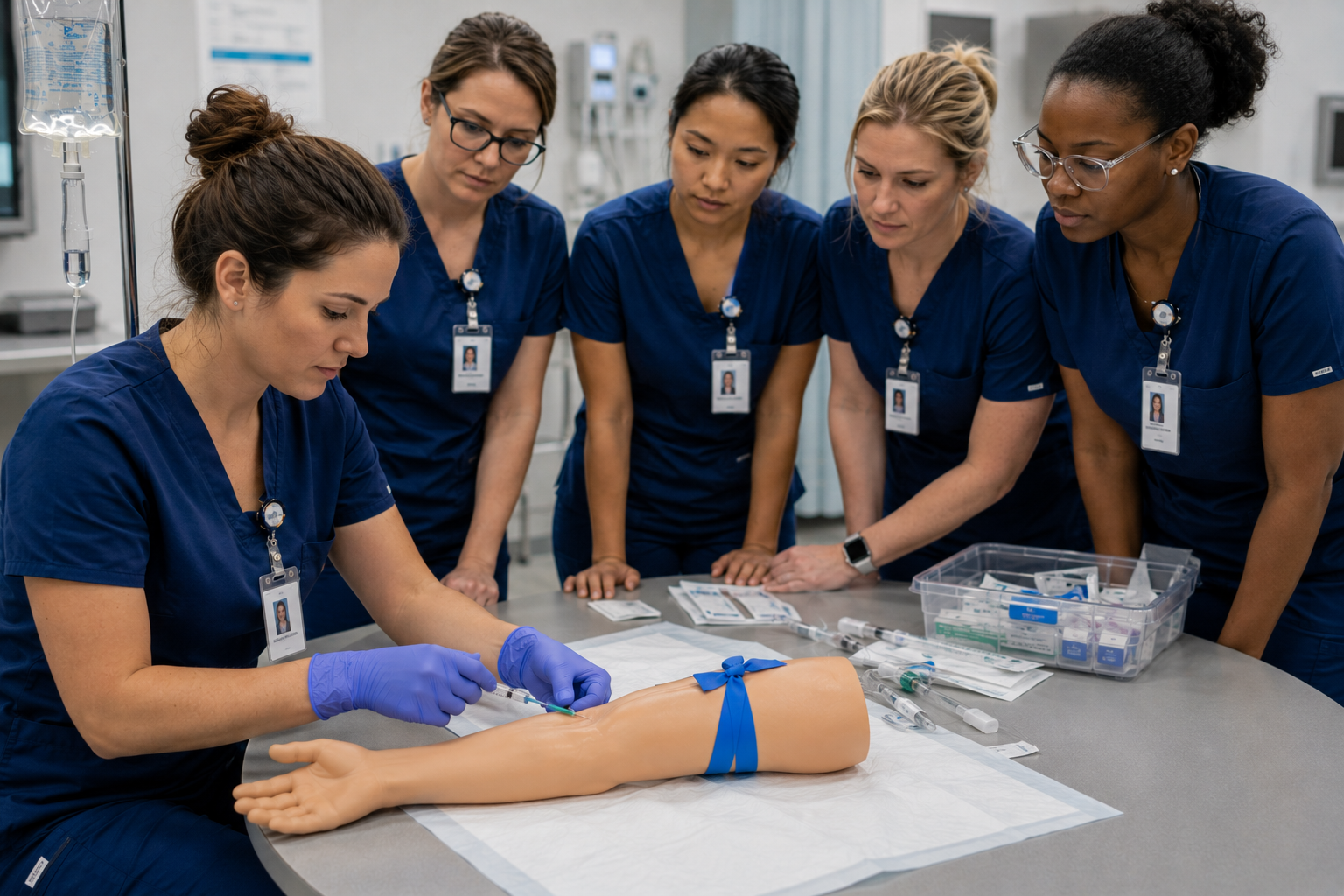
Watching educational videos and reading textbooks build valuable knowledge, but clinical confidence develops through supervised practice.
Receiving immediate feedback helps students correct mistakes early and establish safe, consistent habits that improve first-stick success over time.
Common Reasons Clinicians Miss Veins
Even experienced healthcare professionals occasionally encounter difficult access. However, many unsuccessful venipunctures share similar causes.
Common mistakes include:
- Incomplete vein assessment
- Selecting the first visible vein rather than the best vein
- Poor vein stabilization
- Limited palpation experience
- Rushing the procedure
- Inadequate patient positioning
- Insufficient hands-on practice
Recognizing these patterns allows clinicians to continuously improve their technique while providing better patient care.
Why Professional Training Makes the Difference
Venipuncture is a clinical skill that combines scientific knowledge with practical experience.
That's why quality education should include more than lectures.
At Vein Access Technologies, students receive hands-on instruction that emphasizes:
- Proper vein assessment
- Safe venipuncture techniques
- Clinical decision-making
- Patient communication
- First-stick success strategies
- Evidence-based best practices
Students can further strengthen their learning through VAT's educational books, clinical videos, continuing education courses, and innovative learning tools such as veniCuff® and Vein Block®, which are designed to reinforce vein assessment concepts in educational settings.
Healthcare organizations throughout the Greater St. Louis and Metro East region recognize that investing in quality venipuncture education leads to safer procedures, greater clinician confidence, and better patient experiences.
Frequently Asked Questions
Why can't I find a vein?
Patient anatomy, hydration, age, previous medical treatments, and limited palpation experience can all make vein identification more challenging. Improving assessment skills often leads to better success.
What causes veins to roll?
Some veins naturally move beneath the skin during venipuncture. Learning proper stabilization techniques through hands-on training helps minimize this challenge.
Can I learn venipuncture by watching videos?
Instructional videos are valuable learning resources, but they should supplement—not replace—professional hands-on education supervised by qualified instructors.
How can I improve my first-stick success?
Developing better vein assessment skills, improving palpation techniques, and practicing under experienced educators are among the most effective ways to increase first-stick success.
Where can I receive phlebotomy training near St. Louis?
Vein Access Technologies, located in East Alton, Illinois, offers professional phlebotomy, IV, EMS venipuncture, and continuing education programs for healthcare professionals throughout the Greater St. Louis area.
Build Your Venipuncture Skills with Vein Access Technologies
Every successful healthcare professional starts by mastering the fundamentals. Whether you're entering the medical field or expanding your clinical expertise, investing in professional education is one of the best ways to improve confidence, technical ability, and patient outcomes.
Vein Access Technologies has helped educate healthcare professionals through practical, evidence-based instruction for decades. Our hands-on training programs, educational resources, and innovative learning tools are designed to help students build the knowledge and confidence needed for long-term success in venipuncture.
Ready to advance your skills?
Explore our Phlebotomy Training, IV Training, Continuing Education Programs, and educational resources by visiting
Vein Access Technologies
Recent Posts